
What makes oysters fresh?

Updated: May 20
There are real sensory and handling differences between an oyster harvested and consumed straight from the water versus one harvested 7–14 days ago, even if both are perfectly safe to eat.
This post explores the following factors and what makes a fresh and satisfying oyster:
Taste and culinary quality
Food safety factors
Post-harvest handling

Most oyster fans collapse all three of these factors into a single word: “fresh.” But these factors play a nuanced role. What one might find surprising about oysters, is that a little “resting time” can actually improve the taste experience.
Why consumers equate “fresh” with “better”
Seafood consumers generally assume:
shorter time from harvest = higher quality
more ocean flavor
safer product
These assumptions are not irrational as deterioration of most seafood does start immediately after harvest. This is why Tuna species are flash-frozen for the lucrative sushi market.
But when it comes to oysters, spoiling does not occur as fast as you might think. And because we have been conditioned that fin-fish seafood freshness is directly attributed to a very short time from harvest to consumption, most seafood receives a similar judgment.
Research from Auburn University shows oysters gradually change during storage due to:
enzyme activity
microbial growth
loss of glycogen
changes in volatile compounds and liquor chemistry (AUETD)
But properly handled, live oysters do not deteriorate like fin-fish. First of all, one must realize that oysters are considered "live seafood" because they are still alive when they are pulled from the water. And if properly handled and kept at the proper temperature, oysters can be safely returned to the water up to several weeks where they will sense emersion, open, and start to breath and feed again.
During this out of water experience oysters are using sugars and fat to remain alive, but it does not take much. Oysters out of water and kept around 40 degrees puts them in a slow-metabolic state, similar to hibernation. This natural ability is exercised 2X every 24-hour period for several hours in the littoral zone when the tide recedes and exposes oysters to the air. This is how oysters can remain viable for weeks following harvest because shutting down and going dormant is like second nature to them.
Virginia has a restaurant-specific food-safety rule for oysters: Restaurants can serve oysters up to 14-days from the harvest date. This rule is all about risk management.

Virginia’s conservative time limits are primarily driven by:
food safety & approved harvest zones
temperature abuse concerns
Vibrio bacteria risk (see Hot Topic)
traceability/regulatory simplicity
Not because on day 15 oysters suddenly become bad.
Under ideal refrigeration and humidity:
many oysters remain alive and safe well beyond 14 days
industry anecdotes commonly cite 21–30+ days for premium handling (See this Reddit post)
So are ultra-fresh oysters straight from the water always better? This is where it gets interesting. Not necessarily.

Many experienced shuckers and oyster people quietly acknowledge that oysters often benefit form a short stabilization/resting period after harvest before serving. The advantages of a few days of cold storage provides easier shucking. Why?
adductor muscles relax slightly
internal pressure changes
less shell breakage
This effect is well known commercially, and research on HPP oysters even measures improved “shucking yield” following cold storage. (MDPI) see right

Don't get us wrong, a fresh from the water experience is special and unique, despite the greater shucking challenge, but one day at VDH-regulation temperature might as well be seven when it comes to oysters.
Serving straight from the water is also impractical for many. Only one event in our 5-year history (Fire & Ice) was able to provide an ideal straight from the water experience.
A few days of proper cold holding is somewhat analogous to:
resting beef
conditioning cheese
cellaring wine
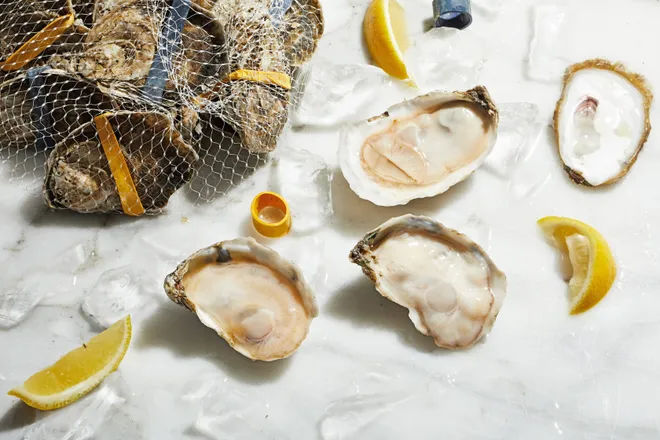
A wide variety of experienced opinions exist on this topic: (Check out this Reddit post)
One of the biggest sensory indicators of freshness is not actually the oyster - it is the retention of liquor. As oysters age, liquor can slowly leak (see our FAQ on storage) which contributes to muscle tissues dehydrating. This changes the eating experience dramatically which is why we favor boxing our oysters and packing them carefully cup side down. (See our “To bag or box” post). The liquor carries:
salinity
aroma compounds
minerality
sweetness perception
Also, cleanliness matters. While well-hydrated oysters inside their shells are nice and cozy, any organisms on the outside of the shell that were not cleaned off after harvest and prior to storage can spoil with age. This is where your nose might confuse the actual suitability of an oyster inside the shell with an overall aroma that screams "do not eat!". Once you nose has detected something like this, it is hard to move past it, even if the oyster is not spoiled.
To recap, so what does "fresh" really mean?

For oysters, “fresh” is less about "harvested this morning" and more about:
continuous cold chain
storage orientation
retained liquor
clean oysters cut down on aroma
From a taste experience, a well-handled 10-day oyster may easily outperform a poorly handled 2-day oyster.
In closing, "fresh" oysters are not simply the ones eaten closest to harvest. The best oysters are those have have been properly handled, kept continuously cold, alive and served within their optimal sensory window. There is credible culinary evidence that a short resting/conditioning period after harvest can improve shuck-ability and sometimes flavor balance. 🦪


Comments